


A single uninsured motorist limit may not tell the whole story after a crash. Stacking uninsured motorist coverage in Florida means applying coverage tied to more than one vehicle to the same accident, when the policy allows it. The policy terms and circumstances of the claim determine whether stacking applies.
It’s understandable to want a clear number when you’re facing injuries and financial pressure. But the coverage potentially available depends on the policy’s stacking terms, which vehicles are insured, and who qualifies for coverage. The wording matters.
This article explains what stacking means, how it may affect your coverage, and which policy details can shape an uninsured motorist claim in Florida. You’ll also learn what to review if an insurer disputes coverage, helping you understand the policy before making decisions about your claim.
Key Takeaways
- Stacking may affect how uninsured motorist coverage across multiple vehicles applies after a crash.
- Policy language and the vehicles covered can shape what coverage may be available.
- Understanding how the policy treats stacking can help clarify the potential coverage for an injury claim.
- Legal support may help when a crash causes injuries and an insurer disputes or challenges the claim.
- For help after a motor vehicle accident, call Charles Injury Law: Call Now: (954) 390-2228 Available 24 Hours a Day, 7 Days a Week.
Stacking uninsured motorist coverage in Florida
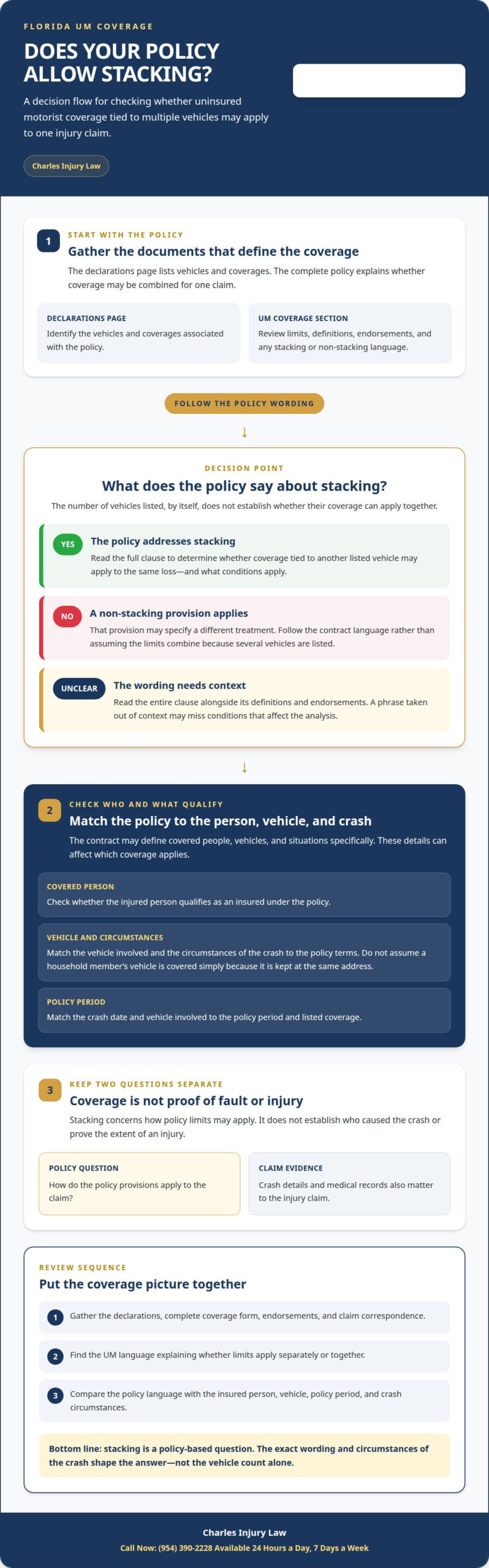
Stacking means applying uninsured motorist coverage connected to multiple vehicles toward one eligible injury claim, if the policy permits it. Rather than considering only one vehicle’s limit, the policy’s terms determine whether coverage associated with other insured vehicles can also apply. The wording, not the number of vehicles alone, controls the analysis.
Uninsured motorist coverage may help address bodily injury losses when an at-fault driver has no insurance or insufficient liability coverage. Stacking does not create a new policy or automatically increase every available benefit. It concerns how existing coverage applies. If a policy lists several vehicles, distinguish the vehicle listing from the terms governing coverage for a particular crash.
Start with the declarations page, which identifies the vehicles and coverages associated with the policy. Then review the uninsured motorist section, including its definitions, limits, endorsements, and any stacking or non-stacking language. The declarations page may list coverage for multiple vehicles, but the full contract explains whether those limits can be combined for one claim.
For example, a household policy may list a sedan and a pickup. A covered person is injured while riding in the sedan, and the other driver lacks adequate insurance. The number of vehicles on the declarations page does not, by itself, establish the amount payable. The policy terms and facts of the loss determine which coverage applies.
A policy that expressly addresses stacking may explain whether coverage tied to another listed vehicle applies to the same loss. A non-stacking provision may specify a different treatment. Read the entire clause alongside its definitions and endorsements. A phrase taken out of context may overlook conditions that affect the analysis.
Identify who qualifies as an insured under the contract. The policy may define covered people, vehicles, and situations specifically. The injured person’s relationship to the policyholder, the vehicle involved, and the circumstances of the crash can all matter. For example, don’t assume a vehicle owned by a household member is covered simply because it is kept at the same address.
Keep the coverage question separate from the injury claim. Stacking concerns how policy limits may apply; it does not establish who caused the crash or prove the extent of an injury. The claim also depends on evidence, including crash details and medical records, as well as the policy provisions. This distinction helps keep assumptions about coverage from replacing a full claim review.
One unrelated income threshold should not be confused with an auto policy term: according to Kaiser Family Foundation, household income must be at or below 133 percent FPL for the applicable family size. That figure concerns an income eligibility measure, not the number of insured vehicles or the calculation of uninsured motorist coverage.
For a practical review, gather the policy declarations, complete coverage form, endorsements, and claim correspondence. Match the crash date and vehicle involved to the policy period and listed coverage. Then find the language explaining whether limits apply separately or together. This helps identify the relevant contract questions without assuming that multiple vehicles automatically mean stacked coverage.
In short, stacking is a policy-based question: can uninsured motorist coverage tied to multiple vehicles apply to one injury claim? The exact policy wording and circumstances of the crash shape the answer. Reviewing both can help determine whether the insurer’s coverage position follows the contract.
Personal Injury Attorney in Fort Lauderdale
A personal injury attorney in Fort Lauderdale can help injured people understand how an uninsured motorist coverage dispute relates to an accident claim. The firm represents people hurt in car accidents, as well as truck, rideshare, and pedestrian accidents. If you’re seeking attorneys for personal injuries or a personal injury firm near me, support can help clarify the claim and the insurer’s position.
People searching for an injury lawyer near me, a personal injury lawyer near me, or lawyers for auto accidents may need help connecting crash evidence to an injury claim. Those seeking auto accident lawyers near me, attorneys personal injury, or personal injury attorneys can also get guidance on the issues that may affect their options.
Contact a personal injury attorney in Fort Lauderdale to discuss your situation. Call Now: (954) 390-2228 Available 24 Hours a Day, 7 Days a Week
Take the Next Step With Confidence
Coverage decisions can shape how you approach an injury claim, but they should not rest on assumptions. Understanding stacking uninsured motorist coverage in Florida can help you ask focused questions about your policy and the insurer’s position. The next step is to connect those coverage questions to the facts of your crash and the injuries you suffered.
If you were injured in a car, truck, or rideshare accident, your claim may involve more than interpreting policy language. The crash circumstances and evidence of your injuries matter, too. Personal Injury Attorney in Fort Lauderdale represents people injured in motor vehicle accidents and can review the issues affecting your claim. Contact the firm to discuss your situation and understand your options.
You deserve a careful review, not pressure or promises. If you’re ready to discuss your situation, contact Personal Injury Attorney in Fort Lauderdale. Take the next step at your own pace, with a clearer path forward.
Disclaimer
The information provided on this blog is for general informational purposes only and does not constitute legal advice. Viewing this content does not create an attorney-client relationship with the firm. You should not act or rely on any information contained herein without seeking legal advice from a qualified attorney regarding your individual situation.